A look at holding title to real estate
By: Robert J. Bruss: Inman News
DEAR BOB: Recently I told my lawyer to include the name of my wife on my home as "joint tenancy with right of survivorship." But when I read the quit claim deed, it says "tenancy by the entireties." Is this the same thing? – Juan A.
DEAR JUAN: No. Tenancy by the entireties is a special version of holding title as joint tenancy with right of survivorship. It is allowed only when a husband and wife hold title to real estate in some states.
The legal result is the signatures of both spouses are required to sell or encumber tenancy by the entireties property. When one spouse dies, the surviving spouse then owns the entire property, the same as with joint tenancy. The deceased's will has no effect on either joint tenancy or tenancy by the entireties property.
By comparison, if title is held in joint tenancy, one joint tenant can usually convey or encumber his/her share alone (thus breaking up the joint tenancy and creating a tenancy in common without the other joint tenant's approval). But this isn't possible when title is held as tenants by the entireties.
States allowing tenancy by the entireties title between husband and wife are Alaska, Arkansas, Delaware, Florida, Hawaii, Indiana, Kentucky, Maryland, Massachusetts, Michigan, Mississippi, Missouri, New Jersey, New York, North Carolina, Ohio, Oklahoma, Oregon, Pennsylvania, Tennessee, Vermont, Virginia, Wyoming and the District of Columbia.
In my opinion, a far better way for spouses to hold joint title to any real estate is in their revocable living trust to avoid probate costs and delays. A second major living-trust advantage is, if a co-owner becomes incapacitated such as with Alzheimer's disease or a severe stroke, the successor trustee (usually the other spouse) can continue managing the property, and even sell or refinance it.
However, if title is held in joint tenancy or tenancy by the entireties, a court-appointed conservator or guardian is required to represent the incapacitated co-owner. Please ask your attorney to explain further.
WHY IS APR (ANNUAL PERCENTAGE RATE) DIFFERENT THAN MORTGAGE INTEREST RATE?
DEAR BOB: I applied for a fixed-rate mortgage. Everything is correct on the Good Faith Estimate of Borrower's Settlement Costs form I was given. But at the closing, I was given a Truth-in-Lending Disclosure which showed the APR (annual percentage rate) is higher than my fixed mortgage interest rate. What is the relationship of these two interest rates? – Ryan H.
DEAR RYAN: The APR is almost always higher than the mortgage's interest rate. The APR is supposed to be a true interest rate after considering up-front borrowing costs.
The reason the APR is usually higher is because it includes costs such as the loan fee, called "points," which is usually amortized over 10 years.
To illustrate, your fixed interest mortgage rate might be 6 percent and that's the interest rate you will actually pay. However, if you paid up-front costs, such as a loan fee, your APR might be 6.125 percent for the same mortgage. For more details, ask your loan officer to explain further.
HOW TO RESOLVE A BOUNDARY DISPUTE
DEAR BOB: Our home is located on 3.5 acres of hilly land. When we purchased about six years ago, we obtained a survey, which is part of our title insurance policy. Recently, the large property next to our property was subdivided and staked by a surveyor. He politely informed us our fence is about 12 feet on the neighbor's side of boundary for a length of about 150 feet. The developer threatens to tear down our fence. But our survey shows the fence is on the boundary. What should we do? – Jess W.
DEAR JESS: Run, don't walk, to the office of the title insurance company that insured your survey as part of your owner's title insurance policy.
The title company should turn the matter over to their title attorney. He or she will probably recommend immediately obtaining a court temporary injunction to prevent the neighbor from tearing down your fence until the boundary dispute can be resolved.
The next step will probably be for you or the neighbor to bring a quiet title lawsuit to determine the true boundary location. Your title insurer should pay the costs of your defense because a loss is threatened.
Although it doesn't happen often, surveyors do make mistakes. Thankfully, your survey accuracy is insured so if you suffer a loss of part of your property, the title insurer must compensate you.
The new Robert Bruss special report, "How to Avoid Buying or Selling a Bad 'Lemon' House," is now available for $5 from Robert Bruss, 251 Park Road, Burlingame, CA 94010 or by credit card at 1-800-736-1736 or instant Internet PDF delivery at www.bobbruss.com. Questions for this column are welcome at either address.
Read more!
Saturday, December 17, 2005
Confusion surrounds joint tenancy for married couple

Friday, December 16, 2005
Real estate sales slow in Southern California
Prices continue to march upward
Inman News
Southern California home sales dropped from November 2004 to November 2005 in several Southern California counties while prices continue to escalate, a real estate information service reported today.
About 27,600 new and resale homes were sold in Los Angeles, Riverside, San Diego, Ventura, San Bernardino and Orange counties in November, which was down 3 percent from October and up 0.6 percent from November 2004, according to DataQuick Information Systems.
A decline from October to November is normal for the season. The strongest November in DataQuick's statistics was in 1988 when 29,303 homes were sold. The slowest November was in 1991 when 13,537 homes were sold. So far this year 326,746 Southland homes have been sold, virtually unchanged from 326,880 for the first 11 months of last year.
"Potential buyers typically get off the fence when interest rates are on the rise, that may account for part of last month's high sales count. Additionally, more homes are on the market these days, giving buyers more choice than they had a few months ago," said Marshall Prentice, DataQuick president.
The median price paid for a Southern California home was $479,000 last month, a new record. That was up 1.3 percent from $473,000 in October, and up 15.4 percent from $415,000 for November 2004. Annual price increases have been in the mid-teens since April.
Home sales activity dropped 9.5 percent in San Diego County, 3.6 percent in Los Angeles County, 1.8 percent in San Bernardino County and 1.6 percent in Orange County from November 2004 to November 2005, while jumping 18.6 percent in Riverside County and 12.1 percent in Ventura County in that time.
Rates for the Real Estate Connect NYC conference (Jan. 11-13, 2006) increase at midnight TONIGHT! Don't miss out. Register now!
Meanwhile, median home prices rose 23.2 percent in San Bernardino County, 20.7 percent in Ventura County, 19.5 percent in Los Angeles County, 17.1 percent in Riverside County, 13.9 percent in Orange County and 6.4 percent in San Diego County from November 2004 to November 2005
The typical monthly mortgage payment that Southland buyers committed themselves to paying was $2,238 last month, up from $2,169 for the previous month, and up from $1,830 in November 2004.
Adjusted for inflation, current payments are about the same as they were in the spring of 1989, at the peak of the prior real estate cycle, DataQuick reported.
"Indicators of market distress are still largely absent. Foreclosure activity is edging up from its bottom, but is still low. Down payment sizes are stable, as are flipping rates and non-owner occupied buying activity," the DataQuick announcement states.
DataQuick, a subsidiary of Vancouver-based MacDonald Dettwiler and Associates, monitors real estate activity and provides information to consumers, educational institutions, public agencies, lending institutions, title companies and industry analysts.
Read more!
Thursday, December 15, 2005
The Weekend Guide! December 15 - December 18, 2005
The Weekend Guide for December 15 - December 18, 2005.
Full Article:
Read more!
Housing Market rounds out record year
California Association of REALTORS® (C.A.R.)
National existing home sales are expected to jump 4.7 percent to 7.10 million units in 2005, which tops last year's record, NAR recently reported in its year-end forecast. The Association also projects new home sales to rise 7.0 percent to 1.29 million units this year.
According to the forecast, the housing market will slow in the year ahead, leveling to a "more normal and balanced market." Despite a decline in sales activity, NAR anticipates the second best housing market on record in 2006. Next year, existing home sales are expected to decrease 3.7 percent to 6.84 million units, while new home sales are projected to fall 4.8 percent to 1.23 million units.
"The slowdown amounts to a tapping of the brakes on a hot market," said NAR Chief Economist David Lereah. "Home sales are coming down from a mountain peak, but they will level-out at a high plateau - a plateau that is higher than previous peaks in the housing cycle."
Read more!
Wednesday, December 14, 2005
40-Year Home Loan Soars in Popularity
By: Gregory J. Wilcox: REALTOR® Magazine Online
An estimated 60 percent of the members of the California Association of Mortgage Brokers expect home buyers to turn to 40-year mortgages to achieve lower monthly payments in the new year.
Higher interest rates also will increase the popularity of 100 percent and adjustable-rate loans, but more than 70 percent of those polled by the group believe such mortgages can be risky for certain borrowers.
According to the association, interest rates will hit 7 percent next year. Many lenders do not offer 40-year mortgages, but Robert Kleinhenz, deputy chief economist for the CALIFORNIA ASSOCIATION OF REALTORS®, says home buyers can opt for shorter loan terms because many will move or refinance within five to seven years.
Read more!
Feng Shui Your Home for the Holidays
By: Karen Rauch Carter: iVillage
The holidays are the time of year you can temporarily add all kinds of chi-enhancing items to your home. Start by introducing yourself to the bagua (the feng shui road map) so you know where all of the key places in your home are.
Next, decide what your priorities are. For instance, do you want to have a harmonious family gathering this year? Add wood, such as a wreath or a Christmas tree, to the "family" area - the left, center of your home or room.
Do you want to improve your health or someone's health in your family? Add fire or sparkling objects, such as stars, twinkling lights or ornaments to the "heath" area - the center of your home or room. Or are you interested in getting more help from people around you? Add angels to the "helpful people" area - the left, front area of your home or room.
Here are nine different ways you can make a difference in your life - just by adding your favorite holiday decorations. Just decide which area (or two!) needs the most help:
Need to enhance your career? Add items that represent water to the front, center area of your home, such as: • Snowmen
Want to bring your family closer together? Add items that represent wood to the left, center area of your home, such as:
• Snowflakes • Christmas tree
Want people to think highly of you? Add items that represent fire to the back, center area of your home, such as:
• Hanukkah bush
• Inherited decorations
• Holly • Reindeer
Want to improve your health? Add items that represent earth to the center area of your home, such as:
• Candles
• Stars
• Lights
• Poinsettias
• Menorah
• Holly • A fresh centerpiece with real earth
Want to get your creative juices flowing, or having problems with children (conceiving, or with children you already have)? Add items that represent metal to the center, right area of your home, such as:
• Poinsettias
• Fresh bowl of fruit or fruit basket • Ornaments
Want to increase your wealth? Add items that represent money to the back, left area of your home, such as:
• Games
• Dreidel
• Instruments
• Train set
• Bowls of ornaments
• Dolls
• Carolers
• Sleds • Gifts (especially the ones you receive)
Need more help in your life from the people around you? Add items that represent people helping you to the front, right area of your home, such as:
• Chocolate Hanukkah gelt (money) • Santa
Looking to increase your wisdom? Add items that represent skills or knowledge to the front, left area of your home, such as:
• Angles
• Gifts (especially the ones you are giving) • Wise Men of the Nativity set
Want to improve your romantic relationships? Add items that represent love or sweetness to the back, left area of your home, such as:
• Religious figures • Chocolates and other sweets!
Read more!
Tuesday, December 13, 2005
A New Way To Hedge Against Housing Declines
Talk about well timed.
By: Alistair Barr: The Wall Street Journal Online
The Chicago Mercantile Exchange plans to offer real-estate futures. Amid concern over a possible slowdown in the property market, nervous investors will able to buy financial products for protecting their portfolios in 2006.
As concerns grow over a slowdown in the recently booming U.S. housing market, new financial products are becoming available that help companies, professional investors and even regular folk to hedge themselves against movements in home prices.
The Chicago Mercantile Exchange, the world's largest futures exchange, is plans to introduce new contracts in April tied to home prices in ten cities including New York, Chicago and Los Angeles.
Earlier this year, online derivatives exchange HedgeStreet introduced contracts based on the future median price of single-family homes in Chicago, Los Angeles, Miami, New York, San Diego and San Francisco, as published by the National Association of Realtors
The U.S. residential real estate market is worth almost $19 trillion, according to Federal Reserve data, making it bigger than the stock market and almost as large as the fixed income market.
But unlike equity and bond markets, until now there's been no liquid market or other efficient way to hedge the risks of movements in real estate. The lack of such tools has become more evident as the recent housing boom has pushed the industry into an even more prominent role in the U.S. economy.
The CME's contracts are mainly designed for companies whose fortunes are tied to real estate markets, such construction firms, developers, mortgage lenders and real estate investment trusts, Craig Donohue, chief executive of the exchange said.
He also expects interest from hedge funds looking to bet on the direction of house prices and said the contracts will also be available to individual investors or the 75 million or so homeowners in the U.S.
The contracts are part of a new clutch of new products that the CME hopes will help to sustain strong revenue and profit growth.
"We're hopeful that it will be a significant contributor," Donohue said. "These are large important risks that need to be hedged."
Email your comments to rjeditor@dowjones.com.
Read more!
Historically Strong Home Sales Expected in 2006
NAR: REALTOR® Magazine Online
The housing market for 2005 is headed for a fifth consecutive annual record, and sales activity in 2006 is expected to be the second best year in history, according to the NATIONAL ASSOCIATION OF REALTORS®.
David Lereah, NAR’s chief economist, said that market conditions are still favorable for housing. “The slowdown amounts to a tapping of the brakes on a hot market,” said Lereah. “Home sales are coming down from the mountain peak, but they will level-out at a high plateau – a plateau that is higher than previous peaks in the housing cycle. This transition to a more normal and balanced market is a good thing.”
The 30-year fixed-rate mortgage should trend up modestly and reach 6.6 percent during the second half of 2006.
Existing-home sales, expected to rise 4.7 percent to 7.10 million this year, are likely to decline 3.7 percent in 2006 to 6.84 million. New-home sales, projected to increase 7.0 percent to 1.29 million this year, are forecast to drop 4.8 percent to 1.23 million in 2006 – also the second best on record. Total housing starts for 2005 should grow 5.8 percent to 2.06 million units, the highest since 1972, and then decline 4.8 percent to 1.92 million next year.
NAR President Thomas M. Stevens from Vienna, Va., said that housing has always been the soundest investment for most families. “As the old saying goes, homeownership beats the heck out of a drawer full of rent receipts,” said Stevens, senior vice president of NRT Inc. According to the Federal Reserve Survey of Consumer Finances, the median net wealth of a homeowner household is 36 times higher than a renter household.
Stevens said that the national median home price has never declined since good recordkeeping began in 1968. “Although there can always be a temporary decline in a given area if jobs are weak and there is an oversupply of homes on the market, people who stay in their homes for a normal period of homeownership generally see healthy returns over time. There are no guarantees, but there are very good odds.”
The national median existing-home price for all housing types, which is experiencing a surge estimated at 12.7 percent to $208,800 for 2005, is expected to rise another 6.1 percent in 2006 to $221,400. The median new-home price is likely to rise 5.5 percent to $233,100 in 2005, and then grow by 7.3 percent next year to $250,100 as higher construction costs impact the market.
The U.S. gross domestic product should grow 3.7 percent for 2005 and 4.1 percent next year. The unemployment rate is expected to decline to 4.9 percent by second quarter of 2006, and then stabilize.
The Consumer Price Index is projected to rise 3.4 percent for 2005, and 2.9 percent next year. Inflation-adjusted disposable personal income is forecast to increase 1.4 percent in 2005 and 4.5 percent in 2006.
Read more!
Monday, December 12, 2005
Real estate's December report card
Guest perspective: Higher loan limits, lower rates signs of positive news
By: John Burns: Inman News
Almost all of the news this month was positive. GDP, job growth, productivity and leading indicators all improved. Consumer confidence rebounded, mortgage rates declined, and new-home sales surged. Sales continue to soften in some markets, but this is not true nationally. The most positive news came from Fannie Mae and Freddie Mac.
The two mortgage giants announced that they will raise the conforming loan amount from $359,650 to $417,000 in 2006, which they claim will allow an additional 466,326 homeowners to become eligible for a conforming loan. Rates on "jumbo" non-conforming loans are typically between a quarter-and-a-half-point higher than conforming rates. The conforming mortgage limits have been rising much faster than home prices. 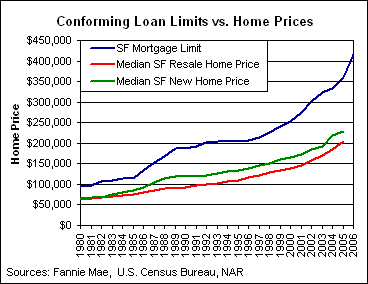
Our grading system of the economy and the housing market is a "bell curve" model, with statistics at an all-time high receiving an "A," statistics near the long-term average receiving a "C," and the worst times ever receiving an "F." In this grading system, it is OK to be a "C" student.
Here is our current report card:
Economic Growth: C
The employment sector improved in November, adding more than 1.9 million new jobs over the last year, a growth rate of 1.5 percent. Unemployment remained flat at 5 percent. Productivity increased 4.7 percent in the third quarter. Inflation rose slightly to 2.1 percent, which is still well below its historical average of 4.2 percent.
Leading Indicators: C
The leading indicator index is up 2.4 percent on an annualized basis over the last six months. The spread between the 10-year Treasury index and the federal funds rate narrowed slightly to 0.45 percent. The stock market improved in November, with each of the indices that we track (Dow Jones, S&P 500, NASDAQ and Wilshire 500) retuning between 4 percent and 8 percent on an annualized basis. The S&P Super Homebuilding Index rebounded in November, returning 10 percent during the month and 35 percent over the last 12 months.
Mortgage Rates: B+
Both fixed rates and adjustable rates rose in November, while the spread between the two continued to narrow for the eighth consecutive month, to 114 basis points. The average fixed mortgage rate rose to 6.28 percent, and the one-year adjustable mortgage rate was 5.14 percent at month's end. The percentage of loans with an adjustable rate stood at 33 percent at month's end, the highest value since June.
Consumer Behavior: C+
Consumer confidence bounced back in November to 98.9, following two months of decline. Falling gas prices and an improving job outlook contributed to the increase. Consumer sentiment improved during the month to 81.6, returning to pre-Katrina levels.
Existing-Home Market: A-
The NAR median home price rose in October to $218,000. Annual sales volume decreased to 7.1 million sales per year, with declines in each region of the country. The inventory of existing homes increased slightly to 4.9 months. The pending home sales index fell in October, but remains very strong at 123.8.
New-Home Market: B
Annualized new-home sales in October rose to an all-time high of 1.42 million units, and the median new-home price rose to $231,300. The Housing Market Index fell to 60 in November. The supply of unsold homes fell to 4.3 months.
Housing Supply: C+
Annualized housing starts decreased to 2.01 million in October, with single-family starts decreasing 3.7 percent to 1.68 million. Total starts increased 1.7 percent in the Midwest and decreased 3.8 percent in the South, 9.6 percent in the Northeast and 15.5 percent in the West. Single-family permits decreased 4.9 percent to 1.68 million units.
John Burns is the founder of Real Estate Consulting in Irvine, Calif., which monitors changes in real estate market conditions and provides consulting services, including strategic planning, market research and financial analysis.
Read more!
Ways to Avoid Winter Damage To Your Home This Season
By: Marshall Loeb: The Wall Street Journal Online
The chill, snow, ice and wind can wreak havoc to your residence's exterior and heating and plumbing systems. Marshall Loeb outlines a few simple steps to protect your house from the elements.
This year, as Jack Frost starts nipping at your nose, remember that he's also nipping at your house, which could force you to make some costly repairs.
Here are some ways to protect your home from winter damage due to chill, snow, ice and wind: • Clean your gutters. Melting snow and ice should be able to flow freely to the
ground. If the freezing water's path is disrupted - a condition called ice
damming - it may seep into your house.
• Trim overhanging, damaged or dead tree branches. Accumulation of snow or ice
on branches, or even strong winds, can cause weak limbs to break. Ice-covered
limbs can be particularly damaging to your home or car - and dangerous to you.
• Maintain the temperature. Keep your thermostat at 65 degrees or higher.
Although you can save on your energy bill by holding your thermostat a few
degrees lower than you normally might, temperatures below 65 degrees will make
your pipes vulnerable to freezing.
• Check your plumbing. Before it gets too cold, inspect your pipes for cracks,
leaks or other damage. Learn how to shut the water off so that you can limit
the damage in the event of a frozen or burst pipe.
• Inspect heating systems. Be certain your home's heat sources - including the
furnace, fireplaces and stoves - are working properly.
Read more!
Sunday, December 11, 2005
Mortgage Options Available To Buyers of Second Homes
Columnist Jane Hodges on the variety of financing options consumers can employ to purchase a vacation house.
By: Jane Hodges: The Wall Street Journal Online
Question: My wife and I want to buy a second home in Florida. We'd use it initially as a vacation home, but might want to relocate there once our son finishes high school. We're not sure how much house we can afford. Can you tell us how securing a mortgage for a vacation property differs from getting a home loan on a primary residence?
- Bobby Hickman, Atlanta
Bobby: In many ways, borrowing to buy a vacation home doesn't differ much from taking out a loan to purchase a primary residence.
"You can do pretty much anything to borrow for a second home that you can to buy a first home," says Dave Craig, a mortgage loan officer at First Horizon Home Loans Corp. in Seattle.
Many second-home buyers pursue a separate, additional mortgage for their vacation property. In the past, a down payment of at least 5% would have been required. These days, says Steven Schneider, a partner with Abacus Lending Group Inc. in Miami and president of the Florida Association of Mortgage Brokers Inc., there are more flexible products available, including interest-only loans (in which you make smaller, interest-only payments for a set period of years, and then pay back both principal and interest in bigger payments) and "pay option" adjustable-rate mortgages (ARMs), where you decide which of a variety of payment forms to make each month. Pay options can include an amount based on a low teaser interest rate (say, 1.5%) available for a short period of the loan, an indexed interest rate that tracks a benchmark rate such as one-year Treasury bills), or fixed rates on a 15-year or 30-year loan, or others.
If home values continue to rise in the state (as they generally have been), loans like interest-only and pay-option ARMs may be good options for second-home buyers, Mr. Schneider says. However, if housing prices come down, or if you always make the lowest payments permissible, it's possible to end up owing more on a house than you bought it for under many pay-option ARM formats. Interest-only borrowers, like buyers of primary homes, sometimes run into trouble when they have to start paying the higher combined mortgage payments for both principal and interest.
If you plan to rent the home out more than 10% of the time, you may be charged a slightly larger loan-origination fee, up to one-and-a-half points higher, to get the same rate a nonrenting owner would, Mr. Craig says. The reason for this, he notes, is that lenders consider loans for owner-occupied property (meaning you use the property the bulk of the time) to be less risky than those on rentals.
Many borrowers finance their second home by tapping the home equity in their primary home. You could consider a "cash-out refinance" of your primary home - a mortgage on your main home that is based on how much your home has appreciated in value since purchase. A cash-out refinancing is more prudent than taking out a home-equity line of credit or a second mortgage on your primary home, as interest rates have been rising more significantly on both home-equity loans and second mortgages, Mr. Craig says. Current rates for home-equity and second mortgage loans can be found at www.bankrate.com.
If you are going to sell your current home when your son finishes school, a traditional adjustable-rate mortgage (ARM) might be a good choice. You could take out a five-year or seven-year ARM with a low initial interest rate. The sale of your primary residence may give you a large influx of cash to make the payments when the rates on your vacation home's mortgage adjust upward. The profit from the sale of your house could allow you to either pay off the loan or pursue other financing options.
- Ms. Hodges is a free-lance writer in Seattle. She answers questions about managing second homes in Owner's Manual. Please send your questions to RealEstateJournal@wsj.com.
Email your comments to rjeditor@dowjones.com.
Read more!
U.S. Home Markets That Are The Most and Least Affordable
Indianapolis, where the median price for new and existing homes was $125,000 in the third quarter, is the most affordable place to buy in the U.S., according the National Association of Home Builders. The priciest homes are concentrated in California, the trade groups says.
By: John Spence: The Wall Street Journal Online
More good news for residents of Indianapolis, where the hometown Colts are sporting an undefeated 11-0 record so far this NFL football season.
The National Association of Home Builders said Thursday that Indianapolis, where the median price for new and existing homes was $125,000, took the title in the third quarter for the most affordable housing market among the nation's major metropolitan areas. About 90% of homes sold were affordable to families earning the median income of $64,000.
Other areas among the most affordable in the country include Youngstown-Warren, Ohio; Detroit-Livonia-Dearborn, Mich.; Buffalo-Niagara Falls, N.Y.; and Oklahoma City, Okla.
However, overall affordability for the nation's housing market dropped to the lowest level since the NAHB began calculating the index in 1992. Roughly 43% of homes sold in the third quarter were affordable to median-income families.
The decline was driven by a 5% gain in the average home selling price from the second quarter, the NAHB said. Meanwhile, mortgage rates were steady, with the average weighted interest rate for fixed and adjustable mortgages gaining only 2 basis points to 5.84%.
"Strong house-price performance is the double-edged sword that has simultaneously attracted and discouraged new home buyers," said Dave Wilson, NAHB president, in a statement.
Not surprisingly, the nation's least affordable housing markets are concentrated in California, with the Los Angeles metro area topping the list, where only 2.4% of homes sold were affordable to those earning the median income. The median sales price for new and existing homes was $495,000, according to the NAHB.
Other California spots on the least-affordable list include Santa Ana-Anaheim-Irvine, San Diego-Carlsbad-San Marcos, and Stockton. Meanwhile, New York-White Plains-Wayne, N.Y.-N.J. was the only metro area outside California that cracked the five least affordable major housing markets, according to the NAHB.
Read more!
Saturday, December 10, 2005
2006 Outlook Continues To Be For A Slower, But Still Busy, Housing Market
Realty Times
Freddie Mac (NYSE:FRE) today released the results of its Primary Mortgage Market SurveySM (PMMSSM) in which the 30-year fixed-rate mortgage (FRM) averaged 6.32 percent, with an average 0.6 point, for the week ending December 8, 2005, up from last week’s average of 6.26 percent. Last year at this time, the 30-year FRM averaged 5.71 percent.
The average for the 15-year FRM this week is 5.87 percent, with an average 0.6 point, up from last week when it also averaged 5.81 percent. A year ago, the 15-year FRM averaged 5.14 percent
Five-year Treasury-indexed hybrid adjustable-rate mortgages (ARMs) averaged 5.78 percent this week, with an average 0.7 point, up slightly from last week when it averaged 5.76 percent. There is no annual historical information for last year since Freddie Mac only began tracking this mortgage rate at the start of this year.
One-year Treasury-indexed ARMs averaged 5.16 percent this week, with an average 0.8 point, unchanged from last week when it averaged 5.16 percent. At this time last year, the one-year ARM averaged 4.15 percent.
“Looking back at 2005, 30-year fixed rate mortgage rates averaged just about the same as they have for the last two years," said Frank Nothaft, Freddie Mac vice president and chief economist. “Since the 30-year fixed rate is the most popular mortgage product by far, these low rates helped the housing market set records for home sales and new construction over the last three years."
“Looking ahead, as mortgage rates rise housing activity will ease somewhat. So although 2006 will not be another record-setting year, it will likely beat the previous record for home sales and new construction set in 2003. In other words, 2006 will be another busy year for the housing sector.”
Read more!
Friday, December 09, 2005
Buying a Rental Property That Will Generate Cash
June Fletcher on how to locate and purchase a multifamily home that can make you money through real-estate appreciation or monthly positive cash flow.
By: June Fletcher: The Wall Street Journal Online
Question: Three years ago, I bought eight single-family rental properties. They have appreciated, but I have negative monthly cash flow. How can I get a no- or little-money down deal on a multifamily unit with positive cash flow?
- Hisashi Nagashima, Schaumburg, Ill.
Hisashi: Before you buy any property, ask yourself, "What's more important, appreciation or positive cash flow?" Single-family homes in the most desirable neighborhoods may appreciate quickly, but because their carrying costs are high, they rarely generate the sort of income needed for positive cash flow. Multifamily units that bring in the bucks each month are likely to be in more modest parts of town and aren't likely to show as great appreciation. You can't expect to dine on T-bone steaks when you're raising roosters.
Then, check track sales records, which you can get from the listing agent or on Web sites like Domaina.com. If appreciation is your goal, then only look at homes that have appreciated well in the past, bearing in mind that the market is cooling. If you want guaranteed positive cash flow, insist that your real-estate agent show you income-producing properties with favorable balance sheets and with established, reputable tenants. Make sure that you see the income and expense statements for these properties for at least the previous two years. Pay attention to what's been done in capital improvements, and what you can expect in terms of maintenance and repair costs, association fees and other expenses.
Most investors want positive cash flow and stable tenants, so don't rush your search. Don't believe those self-appointed gurus who say you can waltz into any town and find a terrific deal within a day without putting down any of your own money. If it were that easy, don't you think they'd be doing these deals themselves instead of traveling from one dingy hotel ballroom to the next, touting their "sure-fire" systems? (Also, remember that plenty of amateur investors have taken these get-rich-quick courses, and are already hounding the relatively few desperate sellers who are the most open to no-money-down schemes - those going through divorce, on the brink of bankruptcy, or who inherited rental property they don't want to manage.)
Once you locate a good income-producing property, consider acquiring it through a tax-deferred IRS 1031 exchange with one of your single-family houses, using a real-estate lawyer or a certified public accountant as an intermediary. Although the process is a bit complicated and only applies to investment properties, the payoff is that you will be able to sell the single-family home to anyone you want without having to pay any capital gains tax on the appreciated value. For a thorough explanation of tax-deferred exchanges, pick up "How a Second Home Can Be Your Best Investment" by Tom Kelly and John Tuccillo (McGraw-Hill, 2004). Also, keep in mind that the positive cash flow that your properties generate is taxable, though it may be sheltered by depreciation. "Real Estate Investing from A to Z" by William H. Pivar (McGraw-Hill, 2004) explains the subject clearly.
To learn more about 1031 exchanges, read the article: "Avoid These Errors in 1031 Exchanges."
June Fletcher is a staff reporter at The Wall Street Journal and the author of "House Poor" (Harper Collins, 2005). Her "House Talk" column appears most Fridays on RealEstateJournal.com. Email your questions about the residential real-estate market. Please include your name, city and state. If you don't want your name used in our column, please indicate that. Due to volume of mail received, we regret that we cannot answer every question.
Read more!