by: Henry Savage: Realty Times
When property values were soaring and the prime rate was at four percent, home equity lines of credit were a great deal. With the prime at 7.25 percent and poised to rise further, folks with HELOCs are in a conundrum.
The scenario is common in most areas across the country: homeowners gloating about their new-found wealth through skyrocketing home values. With double digit real estate appreciation, home equity proved to be abundant.
What better way to take advantage of a smart real estate investment than to borrow against it? These lucky folks could take out a home equity line of credit (HELOC) equal to or near the prime rate.
Seeing as the prime rate was sitting pretty at four percent only a year and a half ago, homeowners were scooping up these loans like it was new found money stashed away in a forgotten hiding place.
But that was 18 months ago.
Consider this real life situation that accurately depicts the conundrum many homeowners are in today, thanks to the unusual interest rate environment.
Last week, I received a phone call from a client who wisely refinanced his 30 year fixed rate mortgage with me back in 2003, when mortgage rates were near 40 year lows. He refinanced his $275,000 balance to a 30 year fixed rate loan at 5.50 percent. His timing was perfect.
Since then, he reads all the news stories about how home values are continuing to rise at an unprecedented pace. At the same time, he is bombarded with media advertisements for HELOCs being offered at great rates.
So my client decides that it might be a good time to make some home improvements. Among other things, he wants to remodel his kitchen, install a brick patio and build a front porch. He goes to his bank and applies for a HELOC, and is delighted to learn that he's been approved for a $120,000 HELOC with an interest rate equal to the prime rate plus one half percent. Since the prime rate at the time was at four percent, the HELOC was carrying an interest rate of only 4.50 percent. To make the deal even sweeter, the bank allows interest only payments on the HELOC for the first 10 years. The monthly payment of the full line is only $450.
So my client closes on the loan, contracts his improvements and realizes he still has over $30,000 left on the line. He uses the balance and buys a new car. After all, $450 is a very affordable payment.
Let's fast forward to the present day. The prime rate has jumped from 4 percent to its current rate of 7.25 percent. Likewise, the rate on my client's HELOC is now at a much-less-desirable 7.75 percent. The payment spiked up to $775.
What's my client supposed to do? He can't stand the notion of the rate on his HELOC rising from four percent to 7.75 percent, and he hates the idea that the rate can continue to rise even more.
I tell him that he can certainly refinance his HELOC to a 2nd trust with a fixed rate, but most 2nd trust programs that carry low fixed rates require a short term, usually 5 or 10 years. A short term loan requires hefty payments. He doesn't want to increase his payment any more than it has already.
So I suggest that we run the numbers to see if refinancing and combining both loans would make sense. My client tells me that he doesn't want to touch his first trust because the rate is so good -- much lower than the fixed rate loans available today. This is true, I tell him, but his 5.50 first trust rate isn't so hot anymore, now that he has an additional $120,000 in mortgage debt that's costing him 7.75 percent.
I suggest that we calculate the weighted average of his mortgage debt.
A weighted average, by definition, is an average that takes into consideration the proportion of each component, rather than treating each component equally.
My client's total mortgage debt is made up of 2 components: a $275,000 1st trust and a $120,000 HELOC. To calculate the weighted average, we take the first trust component and multiply the loan balance by the interest rate. 275,000 X 5.50 percent equals 15,125. We do the same thing with the 2nd component: 120,000 X 7.75 percent equals 9,300.
Next, we add the two sums together: 15,125 + 9,300 equals 24,425.
To determine the weighted average, we then divide this sum by the total mortgage debt: 24,425 divided by 395,000 equals 6.18 percent.
Despite the great interest rate on the first trust, the actual weighted average interest rate that my client is paying for his mortgage debt is 6.18 percent.
I suggest that we refinance the whole ball of wax to one 30 year fixed rate of 6 percent. Such a rate would carry low closing costs and the interest cost of their mortgage debt would drop from 6.18 percent to 6 percent.
What about the payment? He was making interest only payments on the HELOC. Wouldn't his payment rise significantly since there would be an additional $120,000 amortized?
The answer is no. Since the interest rate on the $120,000 drops from 7.75 percent to 6 percent, I see from my calculator that the principal and interest payment on the new loan would only be $32 higher.
There are three distinct advantages to this arrangement. First, $120,000 of their mortgage debt is no longer subject to rate increases. Second, the overall "cost-to-borrow" drops from 6.18 to 6 percent.
Third, in exchange for a slight increase in payment, a much larger chunk of their monthly payment is going towards the curtailment of principal.
It's an unusual market, folks. Not often do you see an interest rate environment where the prime rate is significantly higher than 30 year fixed mortgages. For those who have very large HELOC balances subject to the prime rate, it may not be a bad idea to check the weighted average of your total mortgage debt.
Read more!
Sunday, February 12, 2006
Should Holders of HELOCs Consolidate? Calculating Weighted Average Debt

Saturday, February 11, 2006
Investors cash in on real estate depreciation
Realty Tax Tips-Part 5: Pros and cons of owning properties
By: Robert J. Bruss: Inman News
(This is Part 5 of an eight-part series. See Part 1, Part 2, Part 3 and Part 4.)
In addition to owning your home, do you own one or more investment properties? If you do, or you would like to own real estate held for investment, it pays to understand the pros and cons so you can obtain maximum benefits.
You are not alone. Millions of U.S. homeowners own second homes and other investment properties.
At the recent International Builders Show in Orlando, economists David Berson of Fannie Mae, David Seiders of the National Association of Home Builders, and Frank Nothaft of Freddie Mac agreed house and condo sales to investors are major residential sales factors, perhaps as much as 10 percent of the market.
Their concern is these short-term speculators might all "dump" their properties on the market at the same time, thus causing significant local home-price declines. For this reason, many builders will sell their new houses and condos only to owner-occupants.
WHY INVEST IN REAL ESTATE? During 2005, the average residence appreciated over 10 percent in market value, according to the National Association of Realtors, the National Association of Home Builders, and other reliable sources. Of course, there are a few depressed areas lacking job growth where residential values appreciated slower or not at all.
Compared to the stock market and other alternative investments, real estate stood out as a great investment in 2005, especially for investors who leveraged their purchases by obtaining 80, 90 or even 100 percent mortgage financing. But the home appreciation rate for 2006 is expected to slow down, according to the economists mentioned above, to around 5 percent or 6 percent. However, that is still an excellent rate.
MAJOR TAX BENEFITS OF REALTY INVESTMENTS. A second major reason investors purchase real estate is for the big tax benefits if they "materially participate" in managing their properties. Even investors who hire professional property managers can meet this tax test by making the major decisions, such as setting tenant selection and repair policies, yet leaving the day-to-day operating details to their manager.
To enjoy maximum tax benefits, realty investors who materially participate in owning and managing their properties must own at least a 10 percent interest in the property. This leaves out investors in large partnerships and other group investments such as REITs (real estate investment trusts). Vacation-home owners who place their properties into a "rental pool" managed by others usually do not meet the material participation test.
If you meet these two management and ownership tests, then you can deduct up to $25,000 of your investment property losses against your ordinary taxable income if your adjusted gross income is less than $100,000. Most investment property losses are known as a "paper loss" (rather than an actual cash loss) because they are not cash-out-of-pocket losses.
When your annual adjusted gross income exceeds $100,000, the realty tax loss deduction gradually phases out to zero above $150,000 AGI.
However, unused deductions can be "suspended" and saved for use in a future tax year, or to shelter capital gains from taxation when the property is sold. IRS Notice 88-94 allows use of these suspended tax losses on an aggregate basis, rather than property-by-property, when selling.
The reason is that most investment property paper losses come from the depreciation deduction. Depreciation is a non-cash allowance for "wear, tear, and obsolescence" of the rental property building. Residential rentals must be depreciated over 27.5 years, but commercial properties are depreciable over 39 years on a straight-line basis.
In addition, depreciation is allowed over shorter 5- to- 10-year terms for personal property used in the rentals, such as apartment building washers and dryers. However, land value is not depreciable because it never wears out.
Your car or truck used to operate your investments can also qualify for tax deductions. In addition, equipment purchased to operate your investment property is also eligible for generous tax breaks, including first year expensing, subject to limitations.
THE BEST TAX BREAKS GO TO "REAL ESTATE PROFESSIONALS." If you are a "real estate professional," such as a realty broker, sales agent, property manager, builder, contractor, or leasing agent, you can qualify for unlimited tax deductions from your investment property against your ordinary income.
To qualify for the real estate professional unlimited investment property tax deductions, you must spend at least 750 hours per year, or over 50 percent of your working hours, involved in real estate activities.
DON'T FORGET DEPRECIATION RECAPTURE WHEN SELLING. The only downside of the depreciation tax deduction, which saves income taxes during investment property ownership, is at the time the property is sold Uncle Sam is waiting to "recapture" and tax the total depreciation deducted during the years of ownership.
To make matters worse, Uncle Sam imposes a special 25 percent recapture tax, with a very few exceptions. This tax rate is considerably higher than the current 15 percent long-term capital gains federal tax rate.
However, if the investor dies while owning depreciable real estate that would have been subject to the depreciation recapture tax rate, then Uncle Sam completely forgives all taxes that would have been due if the decedent sold the property before death. In other words, death is the ultimate tax shelter of all.
But capital gains taxes, and the recapture of depreciation tax, can be fully avoided by making an Internal Revenue Code 1031 tax-deferred exchange. To qualify, the replacement property must equal or exceed the old property's equity and cost without taking out any taxable "boot" such as cash or mortgage relief.
CONCLUSION: Investment real estate offers significant tax benefits both during ownership and at the time of resale or tax-deferred exchange. Not only do most investment properties appreciate in market value, but they also produce significant tax savings.
Next week: How tax-deferred exchanges can pyramid wealth.
Read more!
Friday, February 10, 2006
California real estate affordability falls
Home prices jump over 35% in Santa Barbara
Inman News
An affordability index produced by the California Association of Realtors trade group held steady from November to December but was down 5 percentage points since December 2004..
Only 6 percent of households were able to afford a median-priced home along Santa Barbara County's 45-mile-long South Coast in December.
The percentage of households in California able to afford a median-priced home stood at 14 percent in December, compared with 19 percent for the same period a year ago, the group reported today.
C.A.R.'s monthly housing affordability index measures the percentage of households that can afford to purchase a median-priced home in California. C.A.R. also reports housing affordability indexes for regions and select counties within the state.
The minimum household income needed to purchase a median-priced home at $548,430 in California in December was $134,200, based on an average effective mortgage interest rate of 6.33 percent and assuming a 20 percent down payment, C.A.R. reported.
At 24 percent, the High Desert region was the most affordable C.A.R. region in the state, followed by the Sacramento region at 19 percent. Santa Barbara County was the least affordable region in the state at 6 percent, followed by the Northern Wine Country region at 7 percent.
Affordability was also low in the Northern Wine Country (7 percent), Monterey (9 percent), San Diego (9 percent), Orange County (10 percent), Palm Springs/Lower Desert (10 percent), and San Luis Obispo (10 percent) regions, the association also reported.
Home prices increased from $960,000 to $1.3 million (35.4 percent) in the Santa Barbara South Coast area from December 2004 to December 2005, the association reported.
Prices increased 31.1 percent in the High Desert area, 26.2 percent in the Santa Barbara County area, and 20.6 percent in the Riverside/San Bernardino area in that time, according to the report. Price increases were slightest in the North Santa Barbara County area (4 percent), San Diego area (4.6 percent), San Francisco Bay Area (8.2 percent), and Palm Springs/Lower Desert area (8.2 percent) from December 2004 to December 2005.
C.A.R. reported that it will begin reporting the Housing Affordability Index on a quarterly basis – rather than a monthly basis – this year. The first quarter HAI will be released May 4. The California Association of Realtors has about 185,000 members.
Read more!
Home sellers benefit from adjusted cost basis
Part 2: Minimizing home-sale taxes
By: Robert J. Bruss: Inman News
(This is Part 2 of a five-part series. See Part 1.)
The starting point for avoiding long-term capital gains tax on the profitable sale of your personal residence and investment real estate is its adjusted cost basis. This number is needed because it must be subtracted from the property seller's "adjusted sales price" to arrive at the long-term capital gain when the property is sold. Most property owners think their adjusted cost basis is their purchase price. As we will see, that is often wrong!
1. The basic "adjusted cost basis" rule. The starting point is usually (a) the property purchase price, plus (b) any purchase expenses that were not tax deductible at the time of purchase.
EXAMPLE: If you bought your personal residence for $200,000, paid $2,000 in tax-deductible loan fee points to obtain your home acquisition mortgage, and paid $5,000 in various non-deductible closing costs such as transfer fees, attorney or escrow charges, and title fees, your home's adjusted cost basis is $205,000. The $2,000 mortgage loan fee points qualify as an itemized income tax deduction in the year of home purchase. Each "point" equals 1 percent of the amount borrowed. But the mortgage amount doesn't matter for determining the adjusted cost basis.
2. Subtract any "rollover" deferred capital gain from principal residence sales before May 7, 1997. If you used the old now-repealed Internal Revenue Code 1034 "rollover residence replacement rule" before May 7, 1997, don't forget to subtract from your home's adjusted cost basis, as explained above, the amount of any deferred capital gain from the sale of your prior principal residence(s). You might even have deferred "rollover" capital gains from more than one principal residence sales before new IRC 121 replaced the old rule. The new IRC 121 exemption, discussed below, includes these "rollover deferred capital gains.
3. If real estate was acquired in an Internal Revenue Code 1031 tax-deferred exchange, subtract the amount of the tax-deferred capital gain profit from the acquisition cost. Although your tax adviser will calculate your exact adjusted cost basis for property acquired in an IRC 1031 tax-deferred exchange, such as a rental house or an apartment building, a quick shorthand method to estimate your adjusted cost basis of the acquired property is to use your purchase price and then subtract your deferred capital gain resulting from the old exchanged property.
EXAMPLE: Using an IRC 1031 tax-deferred exchange, suppose you had a $100,000 capital gain on the sale of a rental house, which you traded for a $600,000 warehouse. From your $600,000 warehouse purchase price, subtract the $100,000 deferred capital gain to arrive at a $500,000 estimated adjusted cost basis for the warehouse. Of course, be sure to add any non-deductible acquisition costs to arrive at the warehouse's full adjusted cost basis.
4. Add the total costs of capital improvements made during property ownership. Most homeowners and property investors fail to keep accurate records of their total capital improvements added during ownership. Be sure to add the cost of capital improvements to your property's adjusted cost basis. To illustrate, if you paid a contractor to build a new $5,000 deck, or had new landscaping installed for $10,000, those are capital improvement costs to be added to your cost basis. However, if you did the labor yourself, then only the costs of the materials qualify as capital improvements. Your labor is valued by Uncle Sam at zero!
EXAMPLE: If you had a new roof installed on your house for $10,000, add that $10,000 to your home's adjusted cost basis. However, if you just repaired your leaking roof at a cost of $1,000, that's a personal expense without any tax significance because repair costs on a personal residence are neither tax deductible nor are they capital improvements. However, repair costs on an investment property are tax-deductible expenses in the tax year paid.
5. Subtract total property depreciation deducted on your income tax returns. If you rented all or part of your real estate during ownership years, you should have deducted depreciation on your income tax returns. To illustrate, if you rented your house to tenants for a year while you were in Europe, you probably deducted depreciation on your Schedule E of your income tax returns for those 12 months. That's the same place you reported the rental income. Or, if the property was always a rental during your ownership, then you had many years of annual tax-saving depreciation deductions. Add the total depreciation deducted on your tax returns and then subtract the total depreciation from the property's adjusted cost basis.
Depreciation tax deductions must be subtracted to arrive at your home's adjusted cost basis. Most investment property owners are very familiar with the depreciation deduction, which is a major tax benefit of owning depreciable real estate, but it also reduces their property's adjusted cost basis.
HOW TO KNOW YOUR "ADJUSTED SALES PRICE." After estimating your home or investment property "adjusted cost basis," if you are thinking of selling that property, it pays to estimate its adjusted sales price. Briefly, that is the gross sales price, minus non-deductible selling expenses such as the real estate sales commission, transfer taxes, and attorney or escrow fee. Such sales expenses aren't deductible, but they are subtractible from the gross sales price.
Your long-term capital gain is the difference between the adjusted sales price and the adjusted cost basis. This capital gain amount may be eligible for either full or partial tax exemption, or tax deferral, depending on the type of property (principal residence or other property).
Read more!
Thursday, February 09, 2006
The Weekend Guide! February 9 - February 13, 2006
The Weekend Guide for February 9 - February 13, 2006.
Full Article:
Read more!
Forecast Looks Good for Commercial Real Estate
By: Jack Snyder: REALTOR® Magazine Online
With the U.S. economy growing and foreign investment at an all-time high, mortgage industry economists are predicting a solid year for commercial real estate.
"We're looking for a pretty good year, at least as good as last year and possibly better," says Doug Duncan, chief economist of the Mortgage Bankers Association of America.
Lending increased in all commercial sectors last year, with office development leading the way, followed by apartments, retail and hotels.
The mortgage bankers, who are currently holding their annual meeting in Orlando, applauded the recent extension of federally backed terrorism insurance, which they say gave commercial real estate a boost.
Read more!
Buying a House Gets Easier As More Homes Stay on the Market
Inventories are climbing in a number of cities. In another sign of a cooling housing demand, home-builder Toll Brothers reported a 29% drop in new orders.
By: Ruth Simon and James R. Hagerty: The Wall Street Journal Online
With the key spring selling season about to get under way, the inventory of homes on the market is climbing sharply in a number of major cities.
It is the latest sign that the balance of power between buyers and sellers is shifting as the once red-hot housing market continues to cool. The slowdown is affecting both existing homes and new homes. Yesterday, the nation's largest builder of luxury homes, Toll Brothers Inc., reported a 29% decline in new orders in its first quarter, which ended Jan. 31. That was below many analysts' expectations and prompted a sharp selloff in Toll Brothers stock. And Ryland Group Inc., a Calabasas, Calif., builder that sells homes in a wide range of prices, recently announced that new orders declined 4.7% for its quarter ended Dec. 31.
Nationwide, there were 2.8 million existing houses and condominiums on the market at year end, according to the National Association of Realtors. That is down slightly from November's 2.9 million listings, but up 26% from a year earlier. Adjusted for seasonal variations, inventories have climbed 38% since April, according to Goldman Sachs Chief U.S. Economist Jan Hatzius, the largest eight-month increase on record.
The changing climate is particularly noticeable in once-hot markets such as Miami, Phoenix and Washington, D.C., and in areas such as Detroit, where price increases have been modest but the job market is weak. Some brokers report that traffic has increased in recent weeks. But with plenty of properties to choose from, buyers have become more selective.
The rise in inventories has been good news for people like Mike Perillo, an accountant who has been looking for a home in the Philadelphia suburbs for well over a year. "We're now seeing a lot more properties that appeal to us," says Mr. Perillo. "There's more on the market, and there seems to be a lot less people looking now as opposed to this time last year."
In Phoenix, where inventories have climbed steadily since last spring, open houses are attracting a steady stream of lookers, says Charles McLean, broker-owner of Century 21 Metro Alliance. "But people are taking their time," he says. "They're not just jumping and writing a contract." Mr. McLean says that if a listing doesn't attract enough traffic, within 30 days they will consider lowering the price.
In Detroit, sales fell nearly 10% in the fourth quarter and inventories climbed amid uncertainty about auto-industry layoffs. To stimulate demand, Real Estate One, a Detroit brokerage firm, has been running a companywide "Bonu$ Homes" promotion in which sellers agree to provide $2,000 to $10,000 toward buyer closing costs on purchases made before April 15.
"The creativity to sell homes is coming back," says Dan Elsea, president of brokerage services at Real Estate One. "We haven't needed it for years."
Economists and real-estate experts are watching the inventory numbers closely for signs of whether the housing market is poised for a soft landing - or something worse. When inventories are tight, buyers competing for scarce properties bid up prices. As the supply of homes on the market increases, price increases slow and buyers gain negotiating power.
The recent rise in inventories follows a prolonged housing boom during which strong demand and low mortgage rates triggered bidding wars and fueled double-digit price gains in many markets. But those days appear to be over. The National Association of Realtors said that it expects sales of existing homes to fall by 4.7% this year to 6.74 million and median home prices to rise an average of 5%, down from 12.7% last year.
Some analysts are more pessimistic. In a joint forecast issued last month, housing analytics firm Fiserv CSW, a unit of Fiserv Inc., and economic forecaster Moody's Economy.com, a unit of Moody's Corp., called for home prices to increase by an average of 1.5% this year.
With the number of listings rising and the pace of sales slowing, there is now a 5.1-month supply of existing homes on the market, based on the current rate of sales, according to the National Association of Realtors, compared with a record low of 3.8 months in January 2005. Historically, a 5.5-to-six-month supply has been considered a balanced market, says NAR Chief Economist David Lereah. But with the Internet making shopping for a home easier, he says, it is no longer clear just what a balanced market is.
Another uncertainty: how much of the increase in inventories is due to speculators looking to sell, and whether they will be more willing to cut prices as the market cools. Investors accounted for 9.5% of mortgages to buy homes through October, but their share of purchases peaked during the first half of the year, according to LoanPerformance, a unit of First American Corp. Brokers in markets such as Phoenix and South Florida say they've seen an increase in investor-owned properties for sale.
The sharp rise in inventories isn't universal. In Seattle, inventories have declined modestly over the past 12 months as a robust job market sustains demand. The supply is so tight, "I don't know if it can get any lower," says Michael Skahen, owner of Lake & Co., a Seattle brokerage firm.
In Dallas, inventory has edged up slightly, but the pace of sales is up. "The buzz around my office is that everybody is busy now," says Steve Hendry of Re/Max Associates of Dallas. "Our economy seems to be picking up considerably. It's just night and day compared to what was going on this time last year."
Still, the pinch is being felt in many corners of the housing market. The number of completed new homes currently on the market has risen nearly 40% over the past year, according to Hanley Wood Market Intelligence in Costa Mesa, Calif., a market research and consulting firm. The shift has been particularly noticeable where inventories had been thin: In central California, the inventory of new homes climbed to 238 in the fourth quarter, from just 26 a year earlier, an increase of more than 800%.
As orders slow, builders are engaged in heavy discounting and promotional activity, particularly among homes for the second-time, move-up and luxury buyer. A survey conducted last month by the National Association of Home Builders found that 64% of builders are now using incentives such as offers to pay closing costs and free upgrades; 19% are cutting prices.
Last week Standard Pacific Corp., a major builder, said that new orders, excluding acquisitions, fell about 20% in the fourth quarter compared with the same period a year earlier. Lennar Corp., another builder, recently offered discounts of $20,000 to $30,000, plus help with closing costs and bonuses to brokers, on selected homes in the Tampa area.
Robert Toll, Toll Brothers' chairman and chief executive, indicated that slowing orders appeared to reflect three trends. First of all, speculators, who buy homes as investments hoping to flip them later at a hefty profit, are getting out of the market and canceling contracts. Toll said it also is constrained by long delivery times in many communities. During the first quarter, delivery times have increased to 11 months or more - before the maximum was 11 months. Buyers are reluctant to commit to such a long delivery time when the future of the market is uncertain. Toll also has a big exposure to Washington, D.C., New Jersey, Phoenix and California - markets that appear to slowing more rapidly than some others.
The supply of unoccupied condominiums is also climbing in many areas. In New York's Westchester County, the number of condos on the market jumped to 617 at the end of 2005 from 397 a year earlier. In the Boston area, the number of condos listed at the end of January was 5,114, up from 2,876 a year earlier. In the Washington, D.C., metro area, new-home inventory climbed by more than 900% to 2, 413 in the fourth quarter over the same period a year earlier, largely because of the completion of several condo projects, according to Hanley Wood.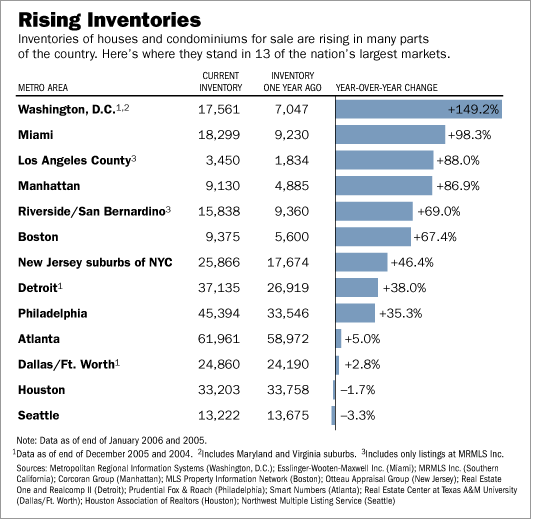
Read more!
Wednesday, February 08, 2006
2006 Home Sales Slower, But Sustainable
NAR
Home sales this year are expected to stay below the peak levels in 2005 but will remain historically strong, according to the NATIONAL ASSOCIATION OF REALTORS®.
David Lereah, NAR’s chief economist, says the sales slowdown has already occurred. “Right now, home sales are a little lower than projected, but they can be sustained around current levels,” Lereah says. “Sometimes people lose sight of the fact that real estate is cyclical. Even so, sales will continue at a historically high pace with modestly higher interest rates as the year progresses, and 2006 is forecast to be the third-strongest year on record.”
Existing-home sales are likely to decline 4.7 percent to 6.74 million this year, down from a record 7.07 million units in 2005, while new-home sales are expected to fall 8.5 percent to 1.17 million from a record 1.28 million in 2005; both sectors would see their third-best year after the totals for 2005 and 2004. Housing starts are seen at 1.87 million units in 2006, down 9.3 percent from 2.06 million last year.
The 30-year fixed-rate mortgage should rise to 6.9 percent by the end of the year.
NAR President Thomas M. Stevens from Vienna, Va., says home sellers are making some adjustments. “It’s easy to understand that sellers have taken it for granted that it would be fairly easy to sell without much compromise during the recent sales boom,” says Stevens, senior vice president of NRT Inc. “Now that buyers have more choices, it’s even more important for sellers to seek advice from real estate professionals. Pros can recommend the right mix of improvements to maximize return, as well as bridge the differences between buyers and sellers that often arise in the negotiation process. Consumers should keep in mind that not all real estate professionals are REALTORS®, who subscribe to a strict Code of Ethics.”
The national median existing-home price for all housing types is expected to increase 5.0 percent this year to $219,200. At the same time, the median new-home price is projected to rise 5.7 percent to $250,900.
Inflation as measured by the Consumer Price Index is forecast at 3.1 percent in 2006. Inflation-adjusted disposable personal income is likely to grow 3.9 percent this year.
Growth in the U.S. gross domestic product is seen at 3.4 percent in 2006. The unemployment rate should average 4.8 percent this year.
NOTE: Minor revisions to monthly seasonally adjusted annual sales rates for 2002 through 2004 will be made when the January existing-home sales report is released on Feb. 28. Each February, NAR Research incorporates a review of seasonal activity factors and fine-tunes historic data for the past three years based on the most recent findings.
Additionally, within the next two months, NAR will revise national and regional median existing-home price data back to 1999. The fixed reporting sample of representative multiple listing services has been updated to reflect geographic changes over time so that the monthly samples for regional price measurements are as accurate as possible. The changes in price patterns will be consistent with previously reported data.
Editor's Note: For more housing statistics, visit the Research section at REALTOR.org.
Read more!
Windermere eyes second-home market
Launches niche marketing program and destination Web site
Inman News
Windermere Real Estate has launched a new Web site targeting resort and urban second-home markets across the West. The launch of WindermereDestinations.com is part of a new niche-marketing program within the brokerage company.
In line with Windermere's Premier Properties program, which offers exclusive marketing resources and a distinctive Web site tailored to luxury home listings, the Windermere Destinations program focuses on homes and condominiums located in resort, recreational, and urban destinations across the Western United States.
The development of Windermere Destinations mirrors the growing trend in second-home ownership across the nation. About 1 million vacation homes were purchased in 2004, representing about 13 percent of all homes sold, according to National Association of Realtors statistics. Further NAR data shows a near 20 percent increase in vacation home sales from 2003 to 2004.
"The Windermere Destinations program is in direct response to the steady increase of second-home ownership and the need for specialized, results-driven marketing resources for these buyers and sellers," said Matt Carroll, president of Windermere Real Estate.
Windermere Real Estate has more than 280 offices and 8,000 sales associates serving neighborhoods in Arizona, California, Idaho, Montana, Nevada, Oregon, Utah, Wyoming, Washington and British Columbia.
Read more!
Home Owners Spend Less on Remodeling
By: Sara Schaefer Munoz: REALTOR® Magazine Online
Home remodeling contractors finally have time to take a holiday — whether they want it or not.
In the last few years, many home owners took advantage of low interest rates to refinance mortgages and use the proceeds to pay for pricey home improvements that drove up the value of their homes. Now that rates are higher and the market less frenzied, home owners are not so motivated to undertake extensive projects.
Spending on home remodeling rose just 4.3 percent in 2005, peanuts compared to 2004 levels, which rose 20 percent over 2003, according to estimates from Harvard University's Joint Center for Housing Studies. The center also expects single-digit growth in 2006.
For home owners who do embark on remodeling projects, this could be good news. "For consumers, this means they are going to get contractors who return phone calls, and they are going to be able to get two or three bids, instead of just one," says Kermit Baker, a senior research fellow at the center.
Read more!
Tuesday, February 07, 2006
Housing Counsel: Starker Exchanges Can Defer Your Tax Payment
By: Benny L. Kass: Realty Times
The rules are complex, and the time limitations are strict, but if you plan to sell investment property, the Starker (like-kind) exchange will allow you to defer the profit you make.
Let's take this example. In the 1970's, you and your new spouse bought your first house for $30,000. You raised three children and in the early 1980's, that house was just too small for your growing family.
You bought a larger house, but decided to keep the old residence and rent it out. It is now worth approximately $700,000.
If you sell, you will have to pay capital gains tax on the profit. For this discussion, we will ignore any improvements which you have made, although when you calculate your profit, these improvements will increase your tax basis and thus lower your tax obligations.
You have made a gross profit of $670,000 ($700,000 - 30,000). There are other costs and expenses which will reduce your profit, such as real estate commissions, legal fees, and closing costs, but for our example, these items will not be considered. The current federal tax rate is 15 percent, and thus you will owe the IRS $100,500. You may also have to pay State tax on this profit. There is a way of deferring payment of this tax, and it is known as a Like-Kind Exchange under Section 1031 of the Internal Revenue Code.
This is not a "tax-free" exchange, although that is what it is often called. It is also called a "Starker exchange" or a "deferred exchange." It will not relieve you from the ultimate obligation to pay the capital gains tax. It will, however, allow you to defer paying that tax until you sell your last investment property.
The ideal exchange is a direct exchange. I own investment property A and you own property B (also investment). Both are of equal value. On February 1, 2006, you convey B to me and on that same day I convey property A to you. If there is a written agreement between us that this is to be a 1031 exchange, neither of us will have to immediately pay any capital gains tax on any profit we have made.
However, such a transaction is rarely possible. The logistics of finding the replacement property to be exchanged simultaneously with the relinquished property is very difficult, if not impossible to coordinate.
Many years ago, a man by the name of T.J. Starker sold property in Oregon, pursuant to a "land exchange agreement," but did not receive any money for the sale. Instead, the seller - a couple of years later - transferred replacement property to Mr. Starker. The Internal Revenue Service considered this a taxable sale, but the 9th Circuit Court of Appeals held that this was a deferred exchange which was permitted under Section 1031 of the Tax Code. In other words, the exchange did not have to take place simultaneously.
There are two kinds of deferred (Starker) exchanges: • a forward exchange: you sell the relinquished property, and within the time
limitations spelled out in Section 1031, you obtain the replacement property;
and
• a reverse exchange: you obtain title to the replacement first, and then sell
the relinquished property.
The rules are complex, but here is a general overview of the process. With some important exceptions (discussed below) the rules apply equally whether the exchange is forward or reverse:
Section 1031 permits a delay (non-recognition) of gain only if the following conditions are met:
First, the property transferred (called by the IRS the "relinquished property") and the exchange property ("replacement property") must be "property held for productive use in trade, in business or for investment." Neither property in this exchange can be your principal residence, unless you have abandoned it as your personal house. Your vacation home would also not qualify as investment property, unless you actually start to rent it out more or less full time.
Second, there must be an exchange. The IRS wants to ensure that a transaction that is called an exchange is not really a sale and a subsequent purchase.
Third, the replacement property must be of "like kind." The courts have given a very broad definition to this concept. As a general rule, all real estate is considered "like kind" with all other real estate.
Thus, a single family house can be exchanged for a condominium (or cooperative) unit; raw land can be swapped for an office building, and a farm can be exchanged for commercial or industrial property.
Before you decide to do an exchange, it is important that you determine the tax consequences. If you do a like-kind exchange, your profit will be deferred until you sell the replacement property. However, it must be noted that the cost basis of the new property in most cases will be the basis of the old property. Discuss this with your accountant to determine whether the savings by using the like-kind exchange will make up for the lower cost basis on your new property. Additionally, if your capital gains tax will be relatively small, you may decide just to pay the tax and not be a landlord anymore.
Here is a general overview of the requirements: 1. Identification of the replacement property within 45 days. Congress did not
like the fact that the Starker opinion imposed no time limitations on when
the exchange could take place. Accordingly, the law was amended to require
that the taxpayer identify the replacement property no later than 45 days
after the relinquished property has been sold.
A taxpayer may identify more than one property as replacement property.
However, the maximum number of replacement properties that the taxpayer may
identify is either three properties of any fair market value, or any number
of properties as long as their aggregate fair market value does not exceed
200 percent of the aggregate fair market value of all of the relinquished
properties.
Furthermore, the replacement property or properties must be unambiguously
described in a written document. According to the IRS, real property must be
described by a legal description, street address or distinguishable name
(e.g., The Excalibur Apartment Building).
2. Who is the neutral party? Perhaps the most important requirement of a
successful 1031 exchange is that the taxpayer cannot receive (or control)
even one penny of the net sales proceeds from the relinquished property. All
such proceeds must be held in escrow by a neutral party, and go directly into
the purchase of the replacement property. Generally, an intermediary or
escrow agent is involved in the transaction.
In order to make absolutely sure that the taxpayer does not have control or
access to these funds during this interim period, the IRS requires that this
agent cannot be the taxpayer or a related party. The holder of the escrow
account can be an attorney or a broker engaged primarily to facilitate the
exchange.
3. Take title within 180 days: The replacement property must be obtained no
later than 180 days after the relinquished property is transferred or the due
date of the taxpayer's income tax return for the year in which the transfer
is made. If, for example, you transferred the relinquished property on
December 15, 2005, your tax return is due on April 15, 2006. That is only 121
days. You either have to take title to the replacement property by that date
or get an extension from the IRS so that you can extend out to the full 180
days. It should be noted that as of this year, instead of the four month
automatic extension, you can now opt for a six month automatic extension by
filing IRS form 4868.
4. Interest on the exchange proceeds. The interest which is earned while the
sales proceeds are held in escrow is called the "growth factor," and any such
interest to the taxpayer has to be reported as earned income. Once the
replacement property is obtained by the exchanger, the interest can either be
used for the purchase of that property, or paid directly to the exchanger.
Reverse exchanges: As many taxpayers have discovered, it is sometimes
difficult to meet the 45/180 day requirements. You have found the replacement
property, but do not yet have a buyer for the relinquished property. And the
owner of the new property is not willing to wait until you are able to go to
closing on your current property.
Thus, you may have to go the reverse Starker route. Here, in very general form, are some of the important rules: 1. The taxpayer must arrange for the replacement property to be held in
a "qualified exchange accommodation arrangement." In government language,
this will now be called "QEAA."
2. Qualified indicia of ownership of the property by the QEAA is required. This
means that the QEAA must either have legal title to the replacement property
or other some other arrangement which is acceptable to the IRS to demonstrate
ownership. A land sales contract (also called "contract for deed") may
suffice.
Under this latter arrangement, the QEAA will not have actual legal title, but
will have certain obligations under a contract. This may - depending on state
or local law - avoid having to pay a double recordation-transfer tax.
Otherwise, this tax must be paid when the property is first transferred to
the QEAA and then again when it is transferred to the ultimate taxpayer.
3. No later than five business days after the property is transferred to the
QEAA, the taxpayer and the exchange accommodation titleholder (called the
QEAT) must enter into a written agreement which provides that the latter is
holding the property for the benefit of the taxpayer in order to facilitate
an exchange under section 1031. Generally, this can be accomplished by a
lease of the property from the QEAT to the taxpayer.
4. Both the taxpayer and the exchange accommodation titleholder (the QEAA) must
file separate federal income tax returns, so as to advise the IRS of any
income and expense incurred while the QEAT had ownership of the property.
5. No later than 45 days after the replacement property is transferred, the
taxpayer must identify the relinquished property. The IRS allows the taxpayer
to identify alternative and multiple properties, and if the taxpayer owns
several investment properties, this provides some flexibility as to which
property will be sold.
6. No later than 180 days after the replacement property is transferred to the
QEAT, it must be conveyed to the taxpayer.
7. Perhaps the most important aspect of a reverse Starker is the requirement
that the taxpayer have a bona fide intent to engage in a 1031 exchange.
According to the IRS regulations:
At the time the qualified indicia of ownership of the property is transferred
to the exchange accommodation titleholder, it is the taxpayer's bona fide
intent that the property held by the property ... in an exchange that is
intended to qualify for non-recognition of gain (in whole or in part) or loss
under §1031.
In other words, you cannot buy the replacement property and then - as an afterthought - decide to treat the transaction as a 1031 exchange.
The rules are extremely complex. You must seek both legal and tax accounting advice before you enter into any like-kind exchange transaction - whether forward or reverse.
Read more!
Monday, February 06, 2006
Bathrooms As Home Offices For Type-A Workaholics
By: Jon Weinbach: The Wall Street Journal Online
With a BlackBerry, two mobile phones, three office computers and wireless Internet for his car, Greg Shenkman is never far from his work. But recently the CEO of San Francisco-based Exigen Group eked out more productivity by wiring the final frontier: his bathroom.
When Mr. Shenkman answers the speaker-phone in his shower, the water automatically shuts off. He can open the front door for deliveries while shaving. He's also put the finishing touches on a waterproof computer that will let him answer emails from his sauna. "I took Gates a little too literally," he says. "The flow of information never stops."
So it's come to this. The humble bathroom, long a place of refuge and solitude, is playing quiet host to more workplace transactions. Bathroom business has gone way beyond tapping out furtive emails on a BlackBerry. Lately, more hard-driving homeowners have converted their loos into virtual satellite workspaces, with retractable desks or waterproof touch-screen monitors. Manufacturer Acquinox of New York says sales of its steam shower/whirlpool units - a hands-free phone is standard in each - nearly tripled last year to 14,800 modules. Wisconsin-based Seura, meanwhile, reports rising sales of its vanity mirrors, which feature LCD screens in the glass. The mirrors, starting at $2,400, let users check their tie-knot, then flip a switch to watch the embedded TV.
Many Type-A bathrooms are showing up in high-end "smart homes," which feature computer systems that let homeowners control music, temperature and lights from wall-mounted touch pads. Now, builders and interior designers say, more owners also want toilet-side technology. Future Home, a Los Angeles-based entertainment-system installer, says half of its clients request tech gear in the bathroom, up from about 10% five years ago. A year ago, New Jersey-based smart-home installer Crestron began offering an Internet option on its home touch-screen monitors. And Audio One says about all of the 30 home-automation systems it's installed near its Miami head office in the past year -- prices can reach $200,000 - have featured TVs in the bathroom. "It's become a given," says company engineer David Sussman. "There's not much sanctity left."
For Jeff Borris, the bathroom serves an essential function - helping the sports agent keep constant tabs on the players he represents, including San Francisco Giants slugger Barry Bonds. Mr. Borris's home in Calabasas, Calif., has two bathrooms in the master suite, each with phones and flat-panel TVs so he can field calls and catch clients' games late at night or early in the morning. "My business knows no time, space or geography, so I'll take calls from anywhere," says Mr. Borris. "But I try to be real careful when I'm around water."
Many of these homeowners say they're just having fun taking technology to its extreme. But they're also on the front line of a broader move to trade contemplative solitude for networked productivity. BlackBerrys and cellphones have long let users check in from everywhere, and now laptops can be hauled to any corner of the home: The number of U.S. households with wireless networks more than tripled, to 12.5 million, from December 2003 to December 2005, says Dallas-based technology researcher Parks Associates.
The upshot? According to a recent report by Forrester Research, commissioned by Yahoo, 21% of homeowners with laptops and wireless broadband say they've checked their email in the bathroom. "People feel the need to be able to put out a fire from anywhere," says Catherine Stellin, vice president of research at The Intelligence Group, a trend-spotting firm. "Even from the toilet."
Working in the bathroom, of course, brings old workaholic conflicts (spousal discord, late nights) even closer to home. There's also Warren Struhl's worry - that he'll be outed when making a call from there. Mr. Struhl lives in Boca Raton, Fla., but he's the CEO of snack-food maker Dale & Thomas Popcorn, which is based in Teaneck, N.J., so he conducts much of his business by remote. In the morning, he spends his first quiet moments in the bathroom reviewing his overnight emails. He often dials into work calls on his BlackBerry, and he figures that if he happens into the bathroom, the acoustics may give him away. To avoid embarrassment, he says, he'll cough to cover noises, or press the mute button. "They know by the echo," he says.
Another emerging hazard: the BlackBerry dunk. "There's something magnetic about a BlackBerry and a toilet," says Paul Normand, president of BlackBerry Repair Shop, a Houston company that specializes in fixing the devices. He says he gets about 100 broken units a day, and estimates five to 10 have fizzled out after customers dropped them in a sink, tub or worse. "They get leery when we ask them, 'Was the water clean?'"
Soaked BlackBerry
Melanie Brandman has been victim of two BlackBerry soakings - but says hers has never fallen into the toilet. Once, in the bathroom of a hotel in Turkey, she put her handbag in one sink while running water in a second one. She accidentally tripped the first sink's automatic sensor and flooded the bag with water, swamping her BlackBerry. (The other time involved dropping her device into a Starbucks grande soy latte.) Though she used to take the device into the bathtub with her, now she's much more careful. "I'm just too nervous I'll drop it," says Ms. Brandman, president of a New York public-relations firm. "I'm beside myself when I can't get my emails."
Of course, there's a long, shared history between productivity and the privy that predates even the corporate washroom. Privacy-seeking playwright Edmond Rostand wrote much of "Cyrano de Bergerac" in the bathroom, according to at least one source, "Uncle John's All-Purpose Extra Strength Bathroom Reader." President Lyndon B. Johnson ordered assistants to stand by and take dictation as he performed his toilet routine, writes biographer Robert Caro. Even The Fonz would motion toward the men's room when he invited visitors to "step into my office."
Still, as long as people see bathrooms as private, they will ask that their habits there stay anonymous. That's the case with a client of Lawrence Lanzilli, president of Manhattan-based Smart Home Designs. Mr. Lanzilli recently installed a $150,000 system for a 35-year-old Wall Street investor designed to make its owner productive the moment he opens his eyes. When his client shuts off his alarm, automatic shades gradually let sunlight in the bathroom. Then the towel warmers switch on, the floor warms and the toilet seat heats up.
When he turns on his faucet, a 15-inch LCD screen appears in the mirror with a touch panel full of icons; he can click on a "Bloomberg" logo to see his portfolio, an "email" logo to check messages and a "TV" logo for morning financial news. Behind that screen is a computer. Says the project's consulting architect, Adam Naim of Bricolage Design in Brooklyn, N.Y.: "It feels like it's a computer I'm walking into."
Attorney Brian Bixby says the added productivity is a mixed blessing. Mr. Bixby, chair of the private client group at Boston law firm Burns & Levinson, says his multitasking won him an important account. Checking his email by wireless late one night in the bathroom, he answered a query from a prospective client - and later heard that his 2 a.m. response had helped clinch the deal. Still, Mr. Bixby says it can be annoying to his wife, and remembers the day when work stayed behind at the office. "The concept of 9-to-5 has really disappeared," he says. "If the technology is available to be reached anywhere or anytime, why shouldn't a client expect that?"
Joel Hall had to draw the line. The 40-year-old Los Angeles software developer and engineer is a self-described gadget freak, and he's nearly done with a home-renovation project that will let him control temperatures in any zone of his house, and bring wireless Internet access and a flat-screen TV to his bathroom. "It's a little overkill. When you see these things available, you have to get them," he says. He likes to watch about 10 minutes' worth of news in there, but there's one boundary he won't cross. "I never read my email in the bathroom," he says. "I'm not that far gone yet."
Read more!
Living Large, Condo-Style
Supersized condominiums, or McCondos, are popping up in several cities.
By: Rich Motoko: REALTOR® Magazine Online
Affluent buyers now have access to 20,000-square-foot penthouses in Miami, 16,000-square-foot apartments in Las Vegas, and 10,000-square-foot units in Manhattan.
Experts say McCondos are just another status symbol. Setha Low, environmental psychology professor at City University of New York Graduate Center, compares these buyers to those who flock to gated communities. Low says that these buyers "want to be around other people like themselves."
Trump Group President Michael Goldstein adds that some buyers prefer condos for security, especially if they have large art collections and do not wish to hire private guards. He notes that buyers will spend hundreds of thousands a year in property taxes and tens of thousands per month in maintenance fees.
Professor Robert Fishman of the University of Michigan's Taubman College of Architecture and Urban Planning describes the trend as "elephantiasis," which he defines as "the disease or syndrome of an individual or species that, just before the crash, there's this huge expansion in size."
Read more!
Sunday, February 05, 2006
Out with the cold, in with the new windows
How to select and replace home's old windows
By: Paul Bianchina: Inman News
If you're not relishing the thought of shivering through another winter with your chilly old aluminum windows, installing some new vinyl or upgraded aluminum windows is probably not as difficult as you might imagine, and in many cases is well within the abilities of the do-it-yourselfer. You can even tackle the project in stages, replacing one or two windows at a time as your budget and time allows. (One note about replacing your windows in stages: some window models will occasionally be discontinued and replaced with different ones, so talk with your dealer about your time frame and the availability of the windows you want before you get started).
SELECTING THE REPLACEMENTS
The overwhelming choice for today's homes is vinyl. Vinyl windows are attractive, affordable and very energy efficient. The vinyl frames do not conduct the cold like metal does, and the wide air spaces between the panes of glass offer very good insulating qualities. Vinyl windows are available in a number of different configurations, and when combined with options such as different grid patterns and a couple of different color choices, there's sure to be something available to compliment any architectural style.
If you prefer to stay with aluminum, look for windows with thermally broken frames. These energy efficient designs utilize a small strip of rubber, vinyl or other non-conductive material to separate the inside and outside of the frames, which greatly reducing the transference of cold through the metal frame.
OUT WITH THE OLD
Vinyl and aluminum windows are sold in a variety of standard sizes, in 6-inch increments. They are specified by the width and then the height, so a 5-0 3-6 window would be 5-feet wide and 3-feet 6-inches high. These sizes have been standardized for many years, so chances are that a new 5-0 3-6-vinyl window will slip perfectly into the rough opening of your old 5-0 3-6-aluminum window.
To remove the old window, first remove the exterior trim around the existing window to expose the nailing flange – the metal strip around the window that is used to fasten the window to the wall framing. Carefully remove the nails that were driven through the flange to hold the window in place, and with the help of another person lift the window out of the opening.
If your existing windows do not have trim around them, you will need to cut through the siding around the window to expose the flange. Measure out approximately 2 inches all around the existing window, then use a circular saw to cut through the siding. Remove the flanges nails and the window as described above.
IN WITH THE NEW
Chances are that your old window frame was thinner than the new one, so you will probably need to adjust the inner window surround to match the new window. First, measure from the face of the nailing flange on the new window to the inside face of the window itself. Next, mark this same measurement on the interior window surround, measuring from the exterior face of the wall. Allow an additional ¼ inch, then cut the wood or drywall of the interior window surround. Done correctly, when you slip the new window into the opening, the interior face of the window will butt up to the existing window surround with about ¼-inch gap.
Apply a bead of caulking to the inside face of the flange, and with the help of another person, lift the new window into the opening. Make sure the window is level and centered in the opening, then secure it in place by nailing through the flange into the wall framing. Follow the manufacturer's recommendations for nail size and spacing, and nail into the bottom and side flanges only – do not nail the top flange.
If the old window had trim pieces around it, you can reinstall the old trim (or cut new trim to fit) to cover the nailing flange and finish off the installation. If the old window did not have trim, you'll need to install some now. Select a trim board that fits the architectural style of the house, such as a 1x3 or 1x4. Place a scrap piece of trim against each side of the new window, and use it as a guide to mark the siding. Cut the siding along the marked lines, then cut and install the new trim in the space between the edge of the window and the cut edge of the siding. Caulk the new trim in place.
Finally, complete the interior installation. If the existing window surrounds are drywall, you can caulk or tape the gap between the window and the edge of the surround. For wood surrounds, install a complimentary piece of trim to cover the gap.
Vinyl and thermally broken aluminum windows are available through home centers, hardware stores, and window retailers. Ask to see actual samples before placing your order.
Remodeling and repair questions? E-mail Paul at paul2887@direcway.com.
Read more!